


Best Portable Fan for Travel: 2026 Guide
Table of Contents
- Best Portable Fan for Travel: Top Picks Compared
- Best Handheld Fan for Travel
- Rechargeable Portable Fan Options
- Portable Fan for Airplane Travel: TSA Rules & Packing Tips
- Portable Fan with Long Battery Life
- How to Choose the Right Travel Fan for Your Trip
- Real-World Performance: Noise, Runtime, and Durability
- Frequently Asked Questions
Last Updated: October 12, 2026
Best Portable Fan for Travel: Top Picks Compared
A quality portable fan for travel transforms stuffy airports, crowded trains, and sweltering hotel rooms without adding bulk to your luggage, whether you're heading to a beach resort, attending outdoor events, or commuting in summer. At MN AMERICA, we know travel comfort comes down to practical gear: a portable fan for travel isn't a luxury, it's a smart investment where air conditioning isn't reliable.
Quick Comparison Table
| Product | Price | Battery Type | Best For | Key Feature |
|---|---|---|---|---|
| Portable Turbo Cooling Fan | $24.00 | Rechargeable | Commutes & outdoor walks | High-speed motor, pocket-sized |
| Portable Neck Fan | $24.00 | Rechargeable | Hands-free cooling | 360° airflow, wearable design |
| Rechargeable Water-Mist Desktop Fan | $69.99 | Rechargeable | Hotel rooms & desks | Humidification + cooling |
| USB Water-Cooling Desktop Fan | $44.99 | USB-powered | Compact desk use | Water tank, three speeds |
Best Handheld Fan for Travel
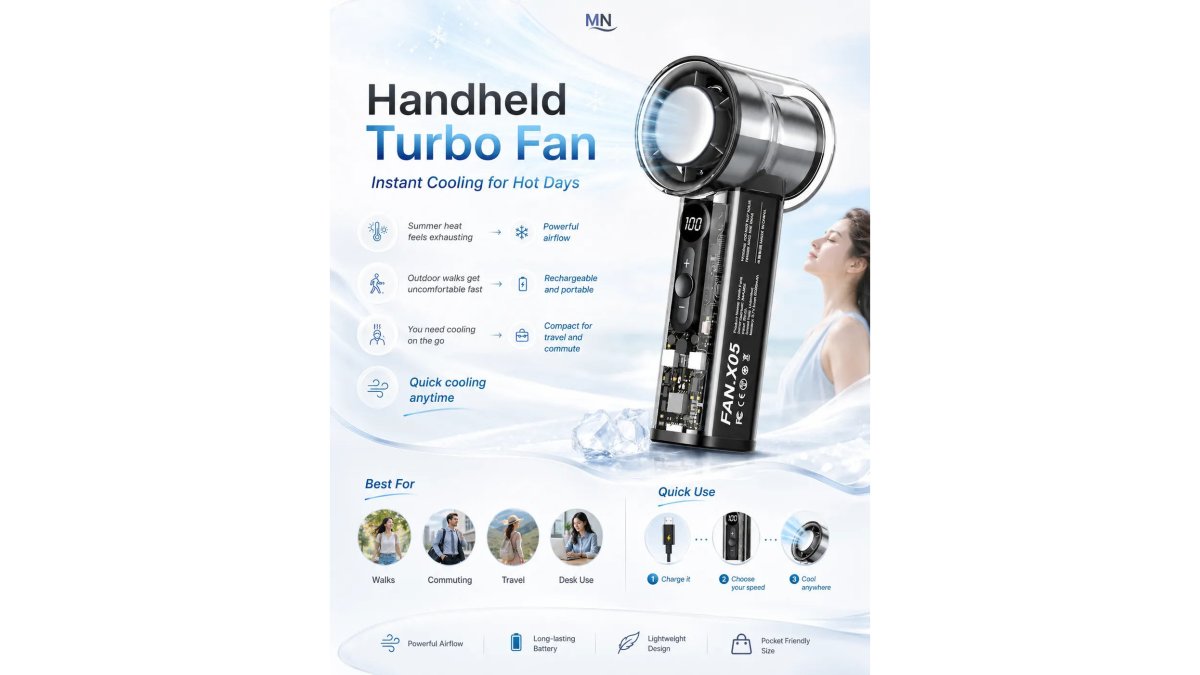
The Portable Turbo Cooling Fan is our top pick for instant relief in a compact package. Its high-speed motor delivers powerful airflow, and at $24.00 it's affordable enough to toss in any bag yet capable when temperatures spike. Its pocket-friendly design slides into a purse, backpack, or cargo pocket, and USB charging works with any power bank or phone charger you carry, cool down in airport terminals, at concerts, on hiking breaks, or while waiting for transportation.

Rechargeable Portable Fan Options
If you want all-day cooling without draining a separate power bank, a rechargeable option saves hassle and money. The Portable Neck Fan ($24.00) rests around your neck and delivers 360° airflow, keeping your hands free.

This wearable design suits travelers who need continuous cooling without holding a device, crowded tourist areas, festivals, and theme park days. The ultra-light build stays comfortable for hours, and USB charging lasts a full day.
The trade-off: for casual travel and active days, the hands-free convenience is hard to beat.
For longer stays, the Rechargeable Water-Mist Desktop Fan ($69.99) adds humidification to cooling, valuable in dry climates or air-conditioned hotel rooms. Three speeds adjust airflow, and the built-in 2000 mAh battery allows cordless placement on a nightstand or desk.
Portable Fan for Airplane Travel: TSA Rules & Packing Tips
Flying with a portable fan comes down to two rules: the battery rule and the packing rule.
The battery rule: watt-hours, not brand names
The TSA and FAA regulate lithium batteries by watt-hours (Wh), not product type, a fan is treated like a power bank or laptop battery. The thresholds:
- Under 100 Wh: allowed in carry-on without airline approval, and generally allowed in checked baggage at the airline's discretion.
- 100-160 Wh: allowed in carry-on only, and only with airline approval. Not allowed in checked baggage.
- Over 160 Wh: not allowed in carry-on or checked baggage.
Most handheld, neck, and small desktop fans use single-cell lithium-ion batteries rated around 3.7 volts. To convert mAh to Wh, multiply by 3.7 and divide by 1,000: a 2,000 mAh battery is about 7.4 Wh, a 10,000 mAh is about 37 Wh, and even a 20,000 mAh fan lands near 74 Wh, under the 100 Wh carry-on ceiling. Nearly every consumer travel fan sits in the unrestricted carry-on tier.
Carry-on vs. checked: what to actually do
For a travel fan, the answer is almost always carry-on. Three reasons:
- You want it during the flight, layovers, and ground transport, none accessible from a checked bag.
- Carry-on avoids the checked-bag battery restrictions that vary by carrier.
- A fan costs you almost no carry-on space.
Packing mechanics that prevent problems
- Empty any water tank before you fly. Misting fans with a filled reservoir can leak under cabin pressure changes, and liquids are restricted by the 3-1-1 rule. Fill the tank after you land.
- Charge to roughly 50-70% before departure. Lithium batteries are happiest mid-range, and a partial charge gives enough runtime for the airport without stressing the cell.
- Keep the fan in an outer pocket or personal item. You want it reachable without unpacking your whole bag at the gate.
- Bring the charging cable in your carry-on. If your fan dies mid-trip, a cable you can't reach is useless.
Using a fan in flight and in the terminal
Once through security, the fan becomes a comfort tool. Terminals and jet bridges are often the hottest part of the journey. On board, cabin air is cool but dry and still, a low-speed fan helps with stuffiness without disturbing seatmates, and neck fans keep your hands free.
One limitation: plan around a single charge. Charge at your gate and top up at your hotel.
Portable Fan with Long Battery Life
Battery runtime matters when you're away from outlets for hours. The Rechargeable Bed Air Circulation Fan ($109.99) delivers the longest runtime in our lineup, 8 to 12 hours depending on speed. It's a larger stationary unit, valuable for travelers renting apartments without reliable air conditioning.
Five speeds balance cooling power against battery drain, and touchscreen operation plus a wireless remote let you adjust from across the room.
For mobile travelers, the Portable Turbo Cooling Fan and Portable Neck Fan both deliver all-day runtime on a single charge at moderate speeds, level 2 or 3 provides over 8 hours of continuous cooling.
Charge overnight, use during the day, repeat.
How to Choose the Right Travel Fan for Your Trip
Selecting the best portable fan for travel depends on three factors: destination climate, trip length, and activities.
Hot, dry climates (deserts, arid regions) benefit from misting capability. The Rechargeable Water-Mist Desktop Fan or USB Water-Cooling Desktop Fan add humidity while cooling. If you're renting a place, they work well on a desk or nightstand.

Humid, tropical destinations need maximum airflow without added moisture. Handheld and neck fans excel here, the Portable Turbo Cooling Fan provides powerful cooling without water tanks.
Active outdoor travel (hiking, festivals, theme parks) calls for hands-free cooling. The Portable Neck Fan takes up no hand or bag space, and its 360° airflow is useful when moving between sun and shade.
Extended stays in one location (week-long rentals, business trips) justify a larger unit like the Rechargeable Bed Air Circulation Fan, set it up in your sleeping area for comfortable nights.
Weight and bulk matter if you're backpacking or traveling light. Handheld and neck fans weigh ounces; desktop fans are heavier and realistic only if you're renting accommodations with room to spare.
Real-World Performance: Noise, Runtime, and Durability
Spec sheets tell you what a fan can do; real-world performance tells you whether it works on your trip. Here's how to read both.
Runtime by speed setting, not by headline claim
A "10-hour battery" claim usually means 10 hours at the lowest speed with the light off. What matters is runtime at the speed you'll actually use. A common pattern:
Noise: decibels in context
Manufacturers quote decibel (dB) ratings, but a number without context is meaningless. Water-mist desktop fans often sit around 36 dB or lower at low speed. Large circulation fans can exceed 50 dB at high speed.
Durability: what actually fails
Brushless motors resist wear from frequent on-off cycling.
Cleaning and repairability
Dust and lint collect on blades and grilles, reducing airflow. Misting fans need the tank rinsed and dried between trips to prevent mineral scale and odor.
Charging compatibility and power-bank performance
All the fans in this guide charge over standard USB or USB-C, so any modern power bank, laptop charger, or wall adapter works. Two things to check before relying on a power bank:
- Output wattage. A fan that draws 10 W needs a power bank that can deliver at least 10 W on the port you're using. A low-output port will charge slowly or not at all.
- Pass-through charging. Some fans can run while charging; others cannot. If you plan to use a fan continuously on a long travel day, confirm it supports pass-through, or carry two fans and rotate.
Frequently Asked Questions
Does TSA allow rechargeable portable fans in carry-on luggage?
Yes, TSA permits rechargeable portable fans in both carry-on and checked baggage. Fans with lithium batteries (under 100 Wh) are allowed in carry-on. Always check with your airline, as some carriers have additional restrictions.
What's the best handheld fan for travel?
The Portable Turbo Cooling Fan is ideal for travel, it's compact enough to fit in any bag or pocket, weighs very little, and features a rechargeable battery that lasts all day. Its high-speed motor delivers powerful airflow despite its small size, making it perfect for commutes, outdoor walks, and quick cooling at your desk. At $24, it's also affordable and fits easily into any travel routine.
How long do portable fan batteries typically last?
Battery life depends on the speed setting. The Portable Turbo Cooling Fan and Portable Neck Fan both deliver all-day runtime on a single charge. The Rechargeable Bed Air Circulation Fan offers 8-12 hours depending on speed selection. Desktop fans with smaller batteries (2000 mAh) generally provide 4-8 hours of continuous use. Always charge before travel and consider a power bank as backup for extended trips.
Are neck fans or handheld fans better for travel?
Both serve different needs. Handheld fans like the Portable Turbo Cooling Fan offer maximum portability and powerful airflow in a pocket-sized design, best for moving between locations. Neck fans like the Portable Neck Fan keep your hands free and deliver 360° cooling around your face, ideal for walking tours or outdoor events. Choose a handheld fan if you need to pack light; choose a neck fan if you want hands-free comfort during active travel.
What should I look for in a travel fan?
Prioritize weight, size, and battery capacity. Look for compact designs that fit in a purse or backpack without adding bulk. Rechargeable batteries are essential, USB charging is standard and convenient. Check noise levels if you'll use it in quiet spaces like hotels or offices. Consider airflow power (speed settings) and whether you want hands-free options like a neck fan. For air travel, verify the battery type meets TSA guidelines.